Unleash your creativity with fun and free Coloring Pages!

Educational Winter Coloring Activities: 30 Fun Learning Printables for Kids
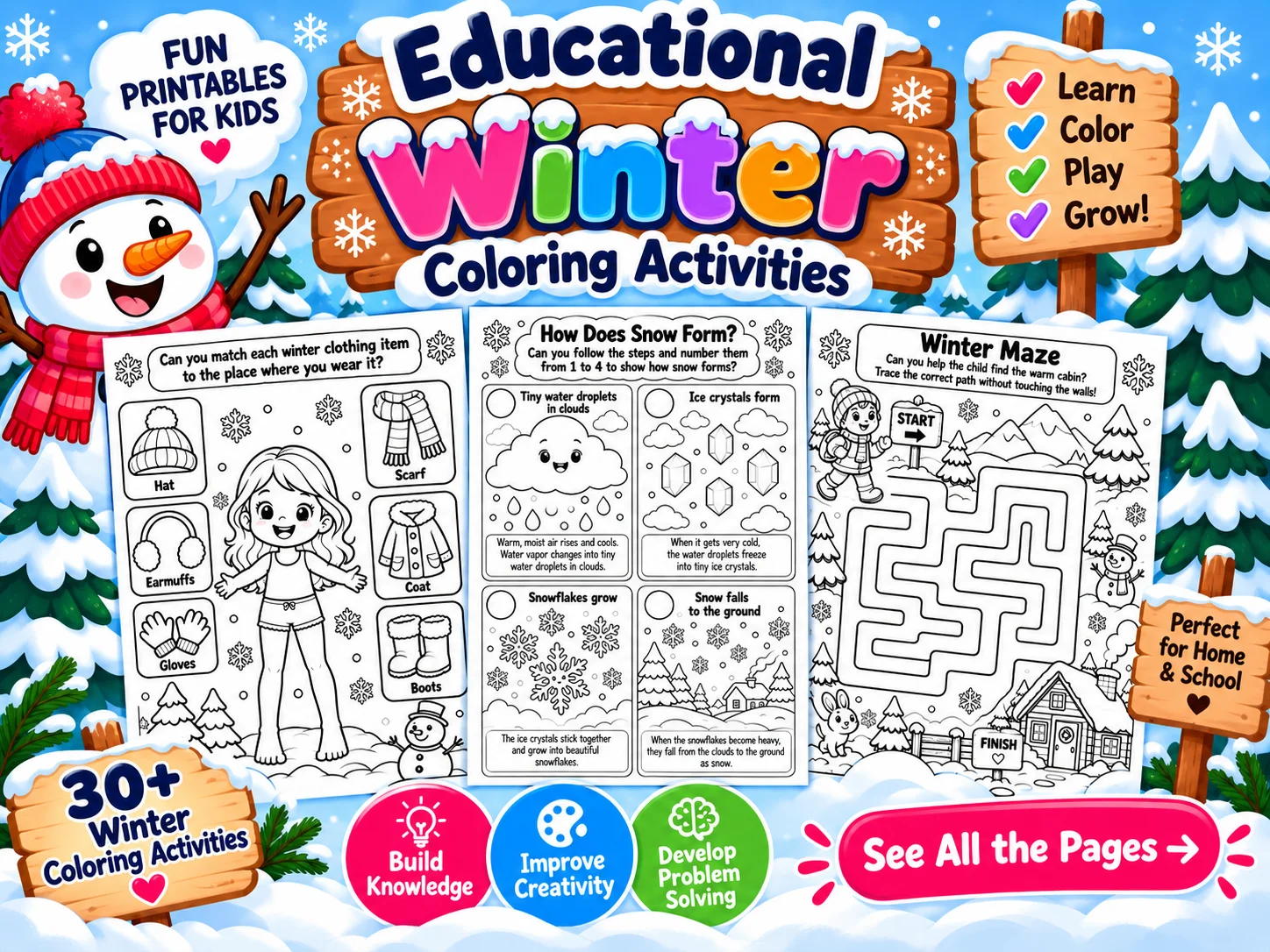
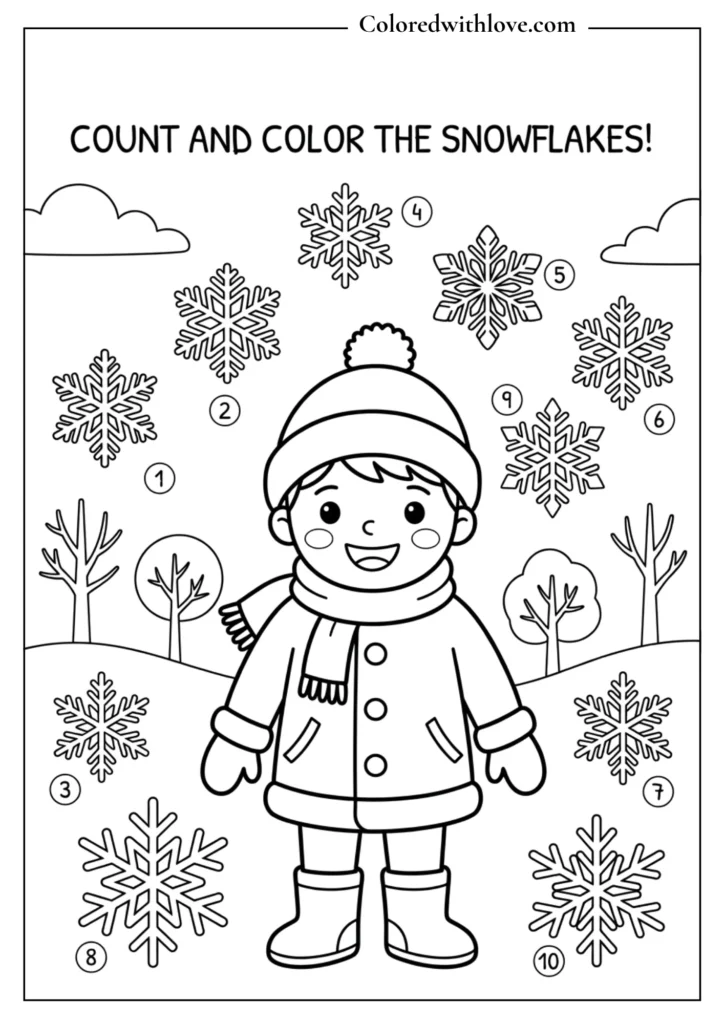
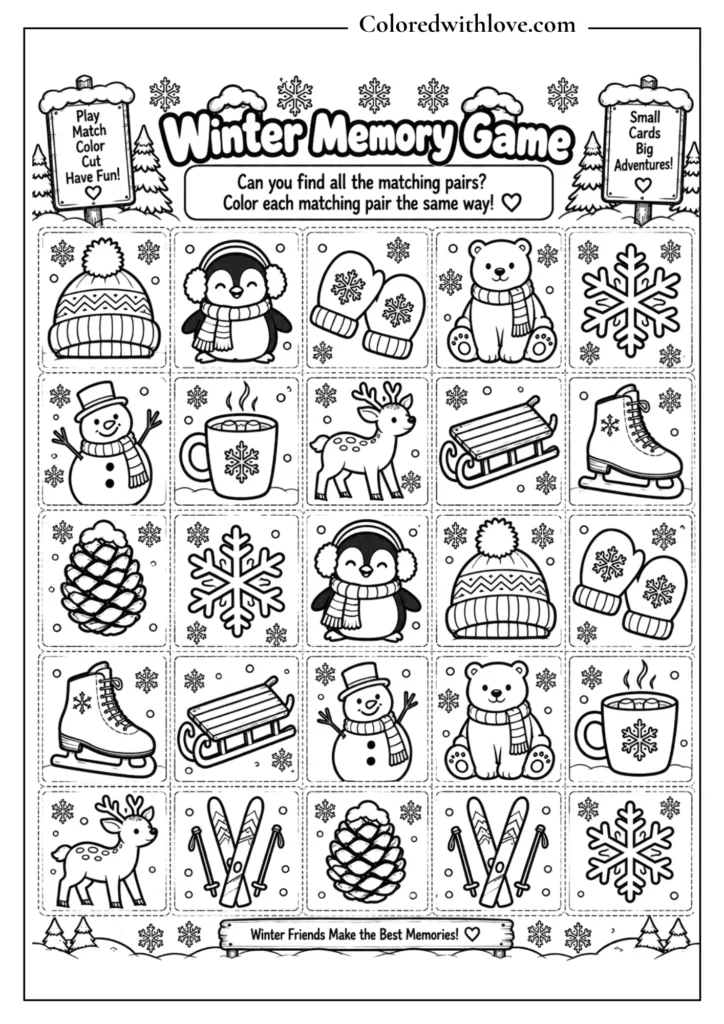
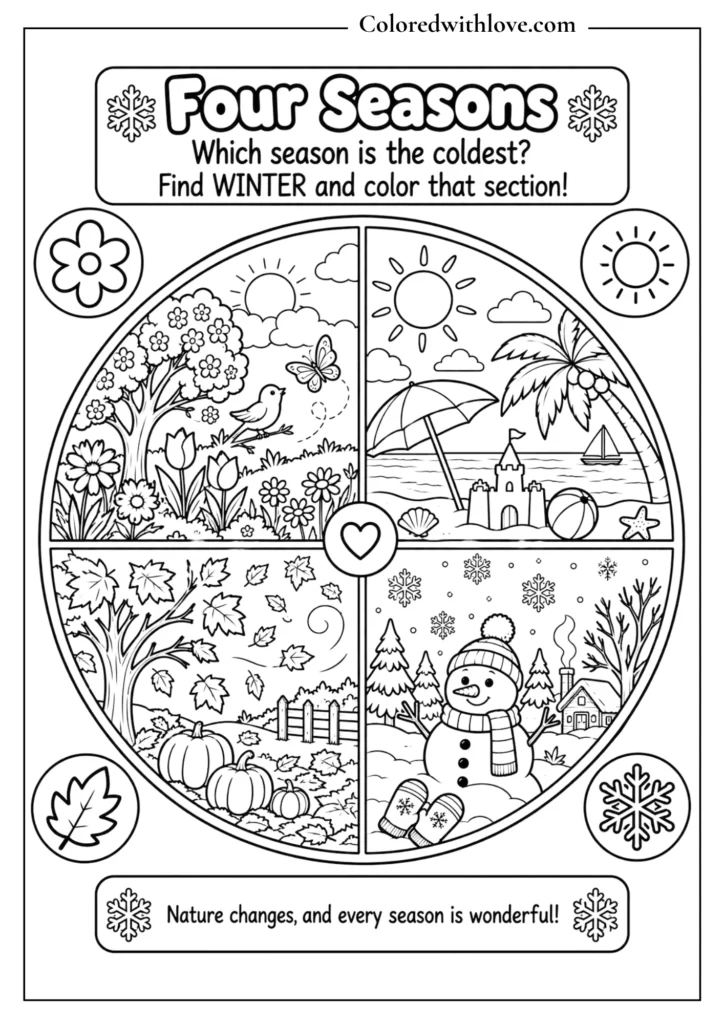
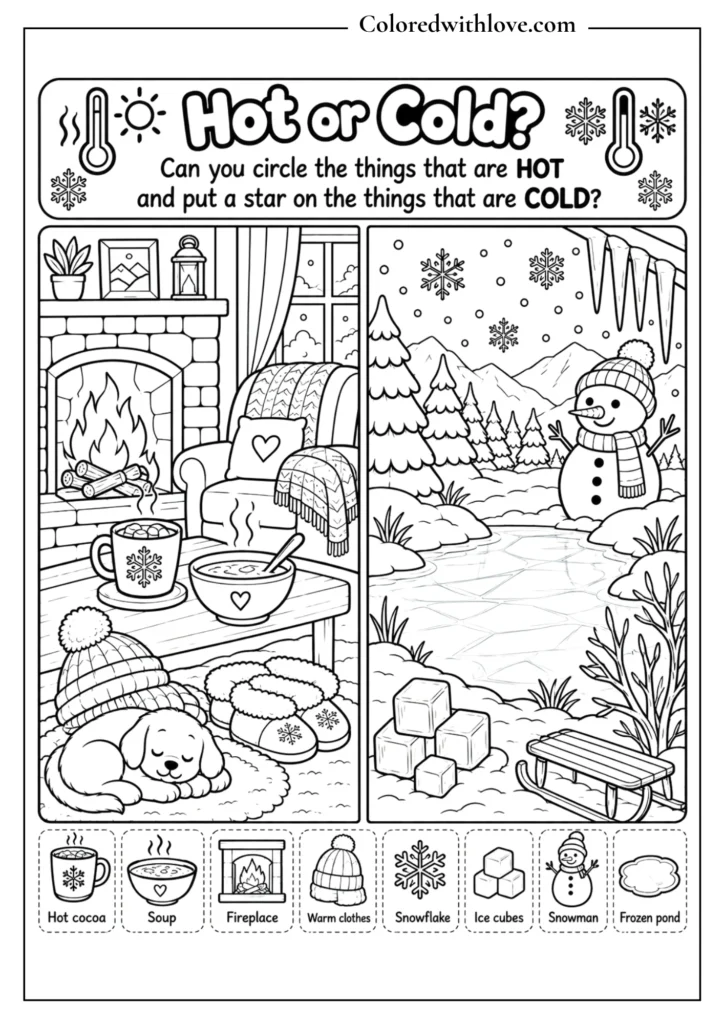
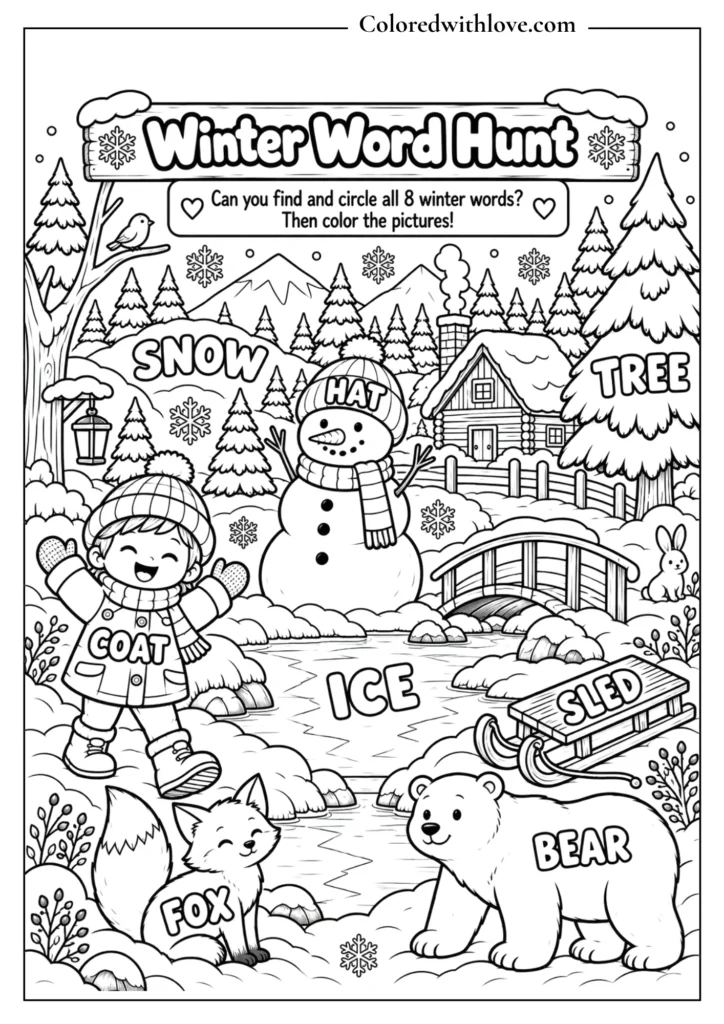
When winter keeps kids indoors, it can be hard to find an activity that is both entertaining and genuinely useful. That’s where Educational Winter Coloring Activities come in. Instead of simply coloring a picture, children can count snowflakes, match winter clothing, identify weather, solve simple math problems, follow mazes, learn vocabulary, and explore animals and habitats.
This 30-page collection from Coloredwithlove.com turns a familiar creative activity into a mini winter learning adventure. The pages give parents and teachers an easy, screen-free way to combine coloring with early learning, observation, vocabulary, sequencing, problem-solving, and winter-themed discovery.
Winter is a great opportunity to turn everyday observations into learning moments. Children can explore ideas such as snow, ice, freezing, melting, weather, and temperature through simple activities at home. PBS KIDS for Parents has a helpful collection of winter activities that combines play with early science and learning.
Learning about seasons can be even more fun when children compare different seasonal themes. After finishing these winter activities, introduce them to our fall coloring pages and let them explore autumn leaves, pumpkins, nature, and other colorful seasonal scenes.
👉 Simply click on any image below to open and download the full PDF version.
Quick Peek Inside !
Why Educational Winter Coloring Activities Are More Than Just Coloring
Coloring naturally invites children to slow down, look closely, and make choices. When you add a question, matching task, counting challenge, or tracing activity, the page becomes much more interactive.
The key idea is simple: children can learn while they play. A child who is counting snowflakes may not feel like they are practicing number recognition and that’s exactly what makes the activity so enjoyable.
These Educational Winter Coloring Activities are especially useful for:
- Preschool and early elementary learning
- Homeschool winter units
- Classroom centers and early-finisher activities
- Quiet time at home
- Screen-free winter break activities
- Parent-child learning sessions
- Winter-themed vocabulary practice
What’s Inside the 30-Page Winter Activity Collection?
This collection covers a surprisingly wide range of winter learning themes. The pages can be used individually or combined into a complete winter activity workbook.
1. Winter Vocabulary and Recognition
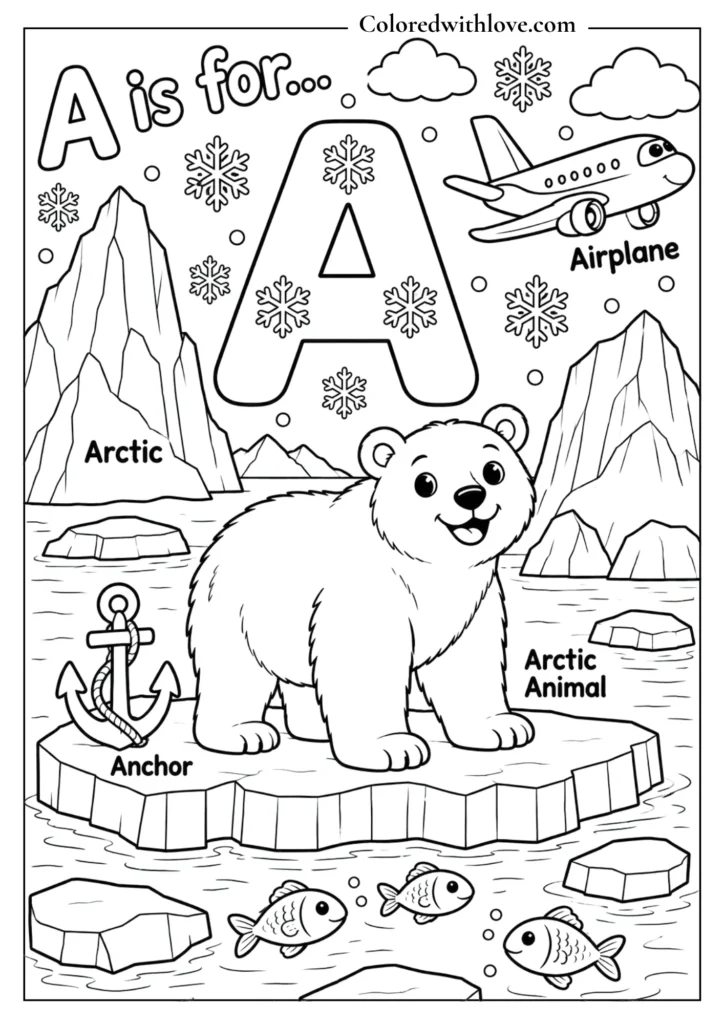
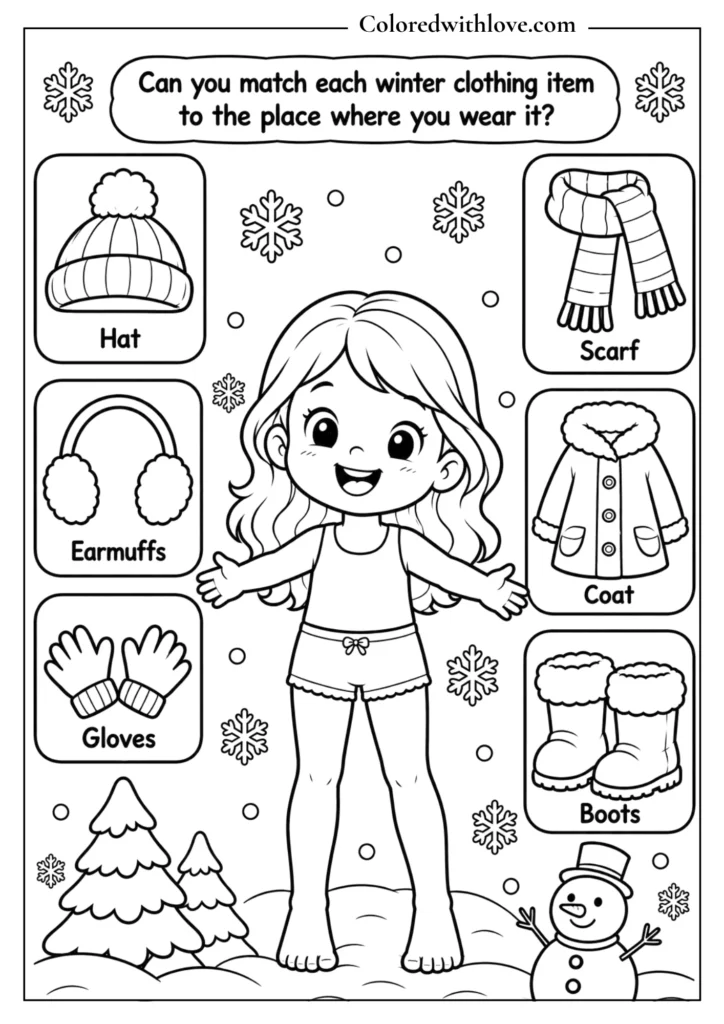
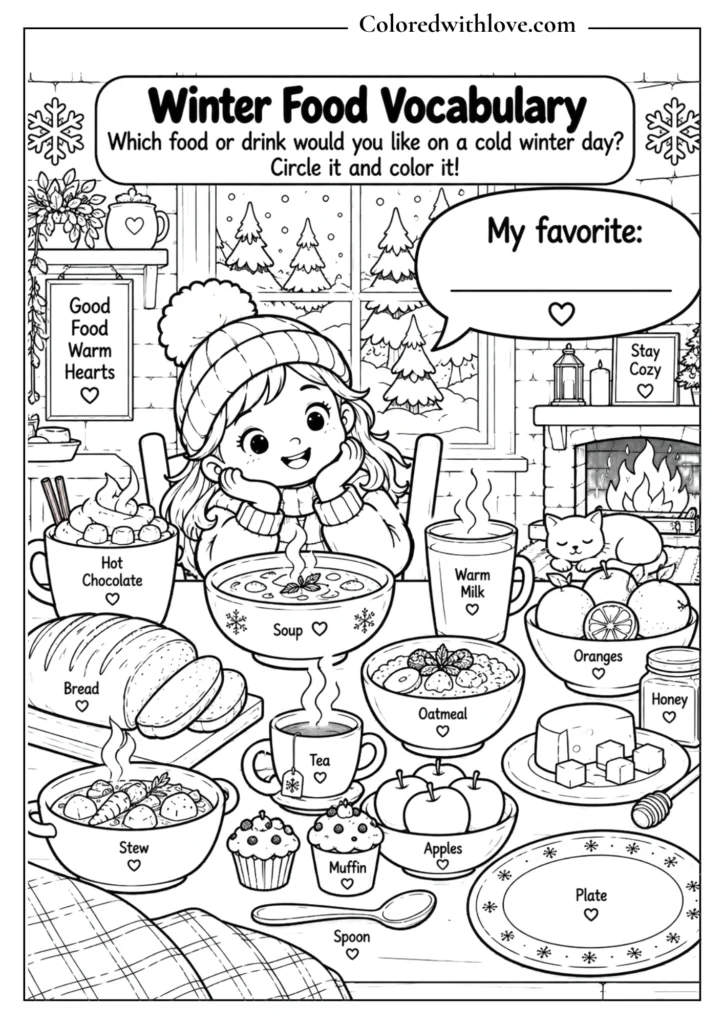
The collection begins with foundational vocabulary and visual recognition. Children can explore an Arctic-themed “A is for…” page, identify winter clothing, recognize snowman body parts, and learn words connected to winter food and everyday objects.
The Winter Objects page takes early literacy a step further by asking children to say the name of each object, find its beginning letter, and trace it. It includes objects such as a snowman, mitten, scarf, hat, sled, snowflake, penguin, and polar bear.
That means one coloring page can become a quick vocabulary, phonics, and handwriting activity.
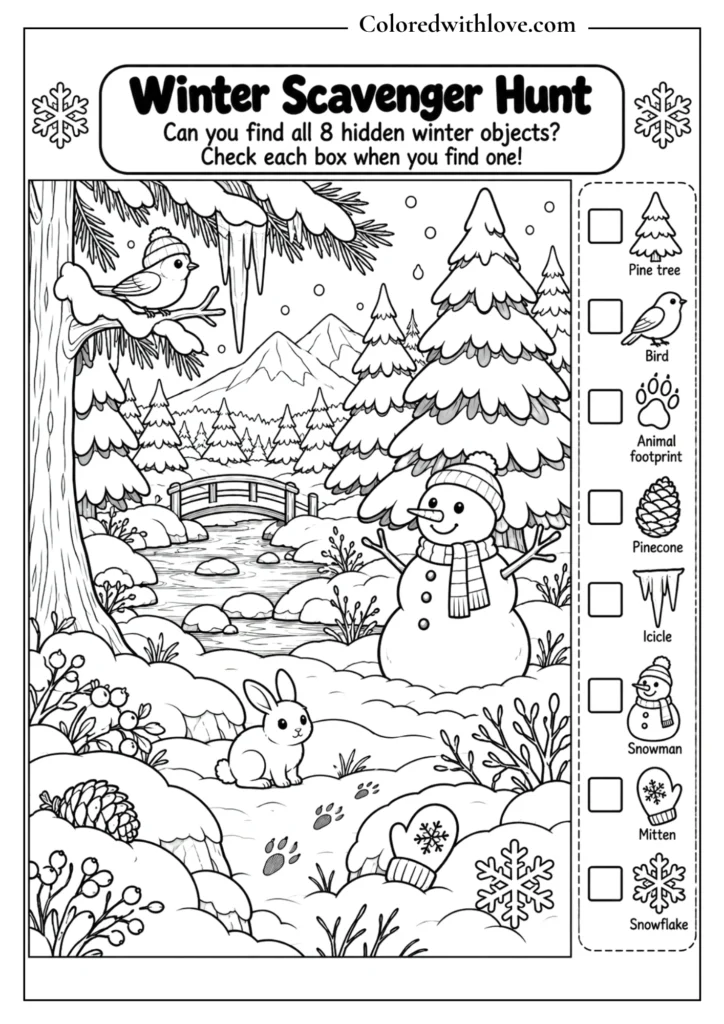
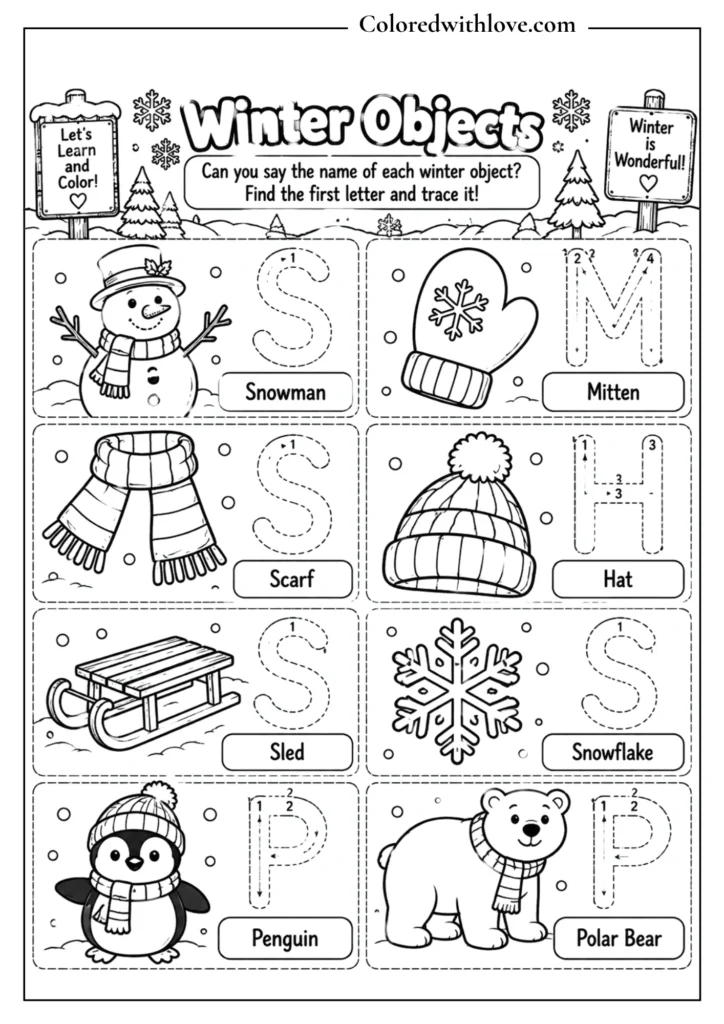
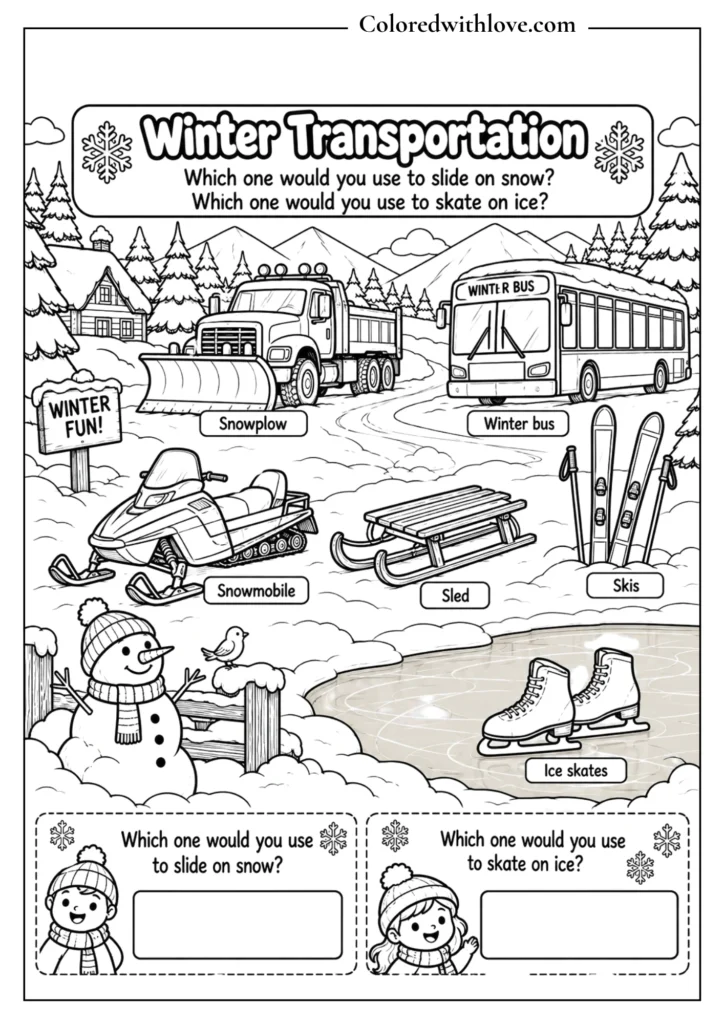
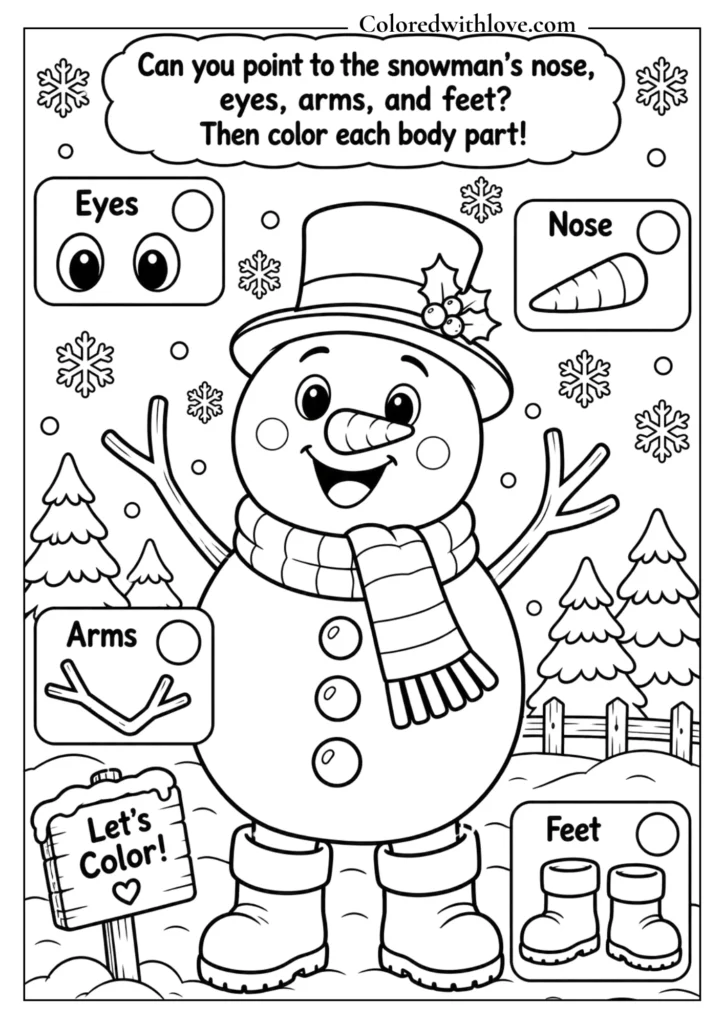
2. Counting, Shapes, and Early Math
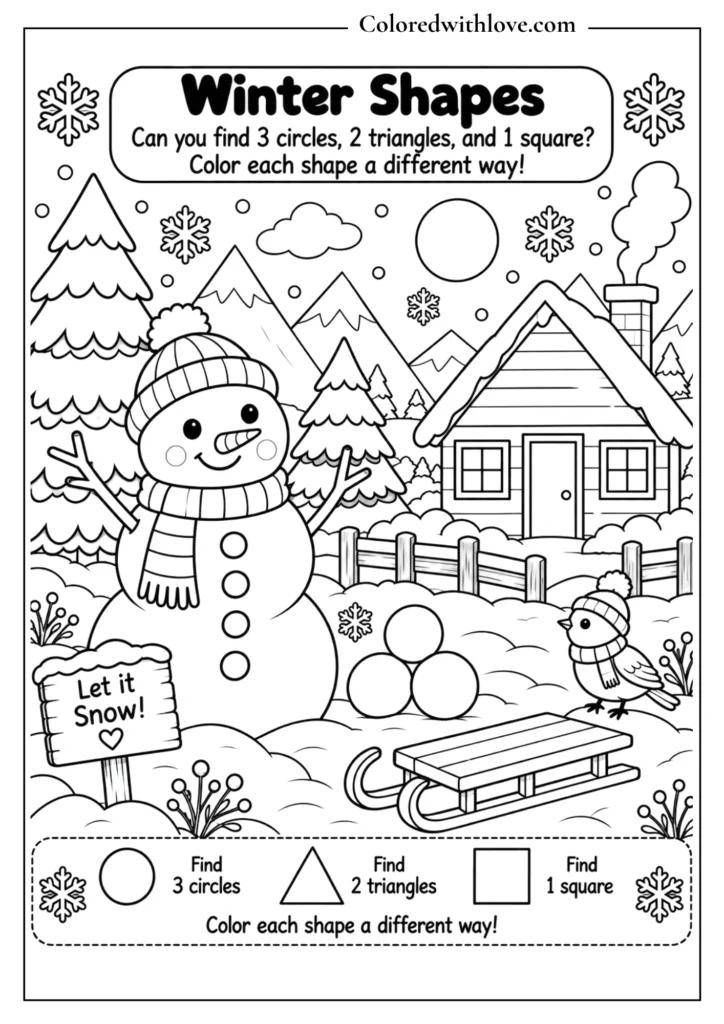
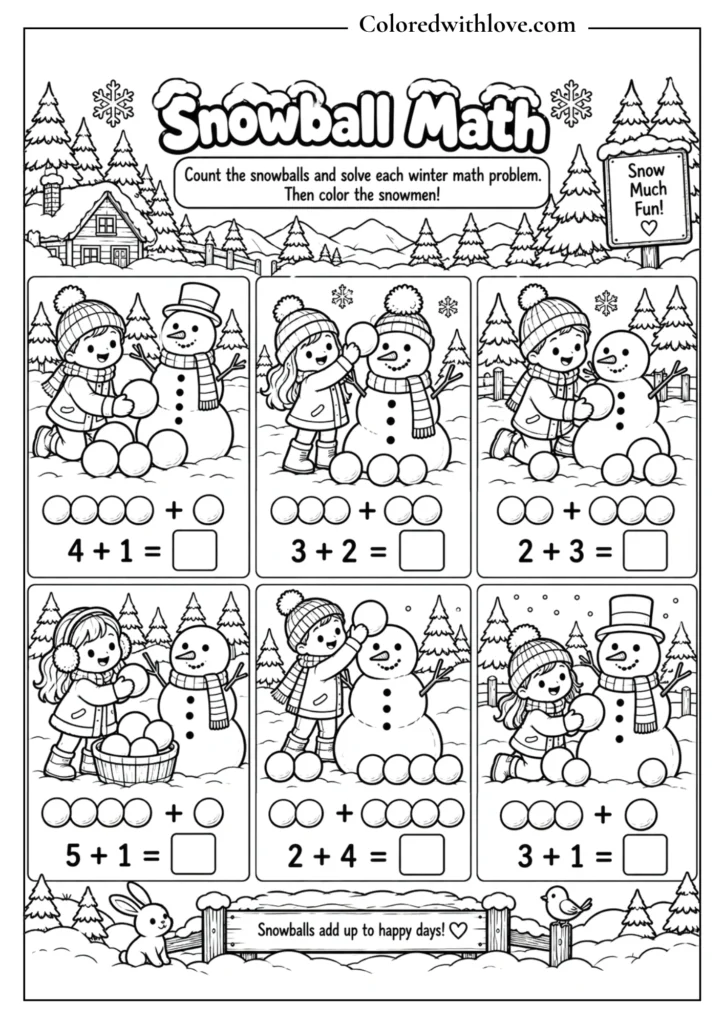
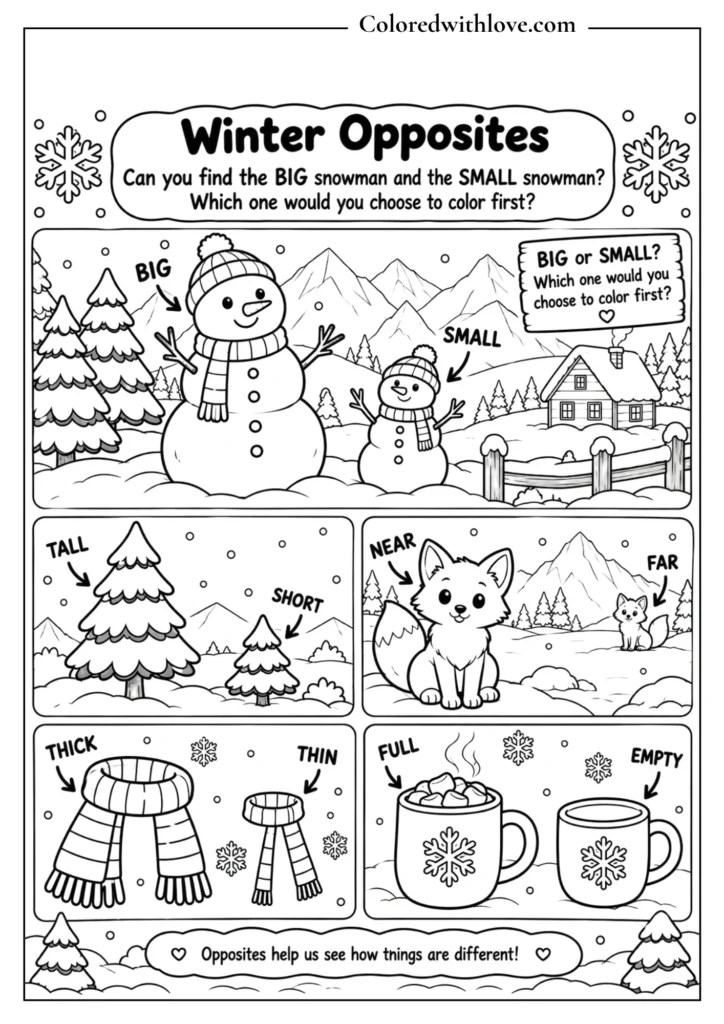
Math practice is woven naturally into the winter theme. Children can count snowflakes, identify circles, triangles, and squares, compare opposites such as big/small and thick/thin, and solve simple snowball addition problems.
The Snowball Math page uses visual addition problems, including equations such as 4 + 1, 3 + 2, 2 + 3, 5 + 1, 2 + 4, and 3 + 1. Because the snowballs are shown visually, children can count the objects before writing an answer.
Try asking:
“How many snowballs do you see before you solve the equation?”
This turns a simple printable into an opportunity to practice counting, addition, and mathematical thinking.
3. Winter Science Made Visual
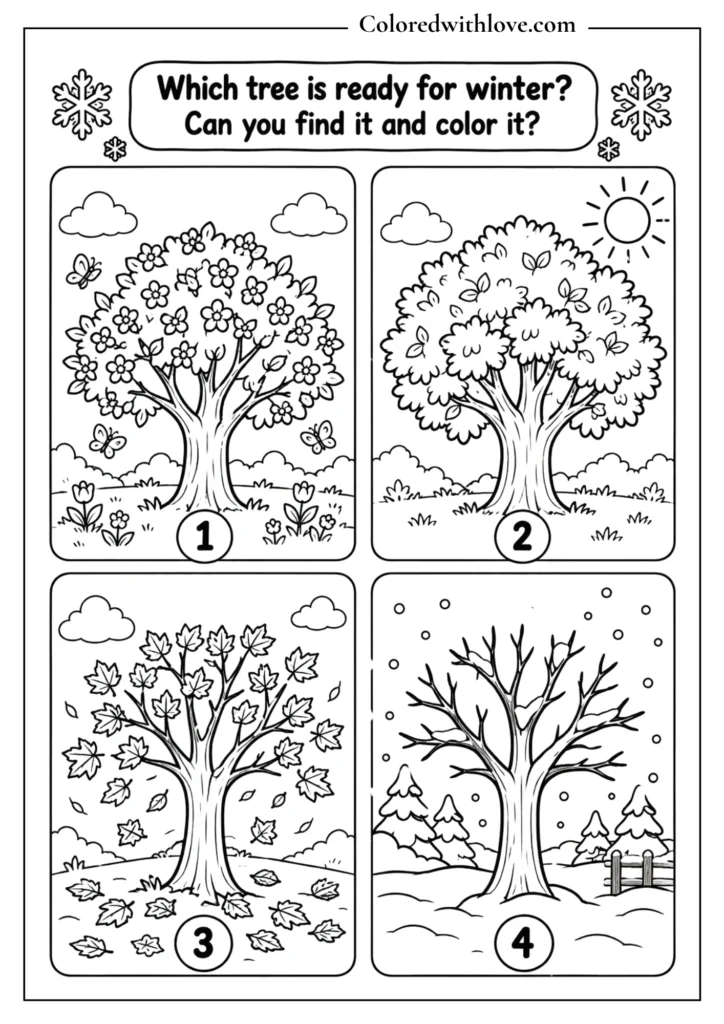
Winter is perfect for introducing basic science concepts because children can see changes in snow, ice, clouds, and water.
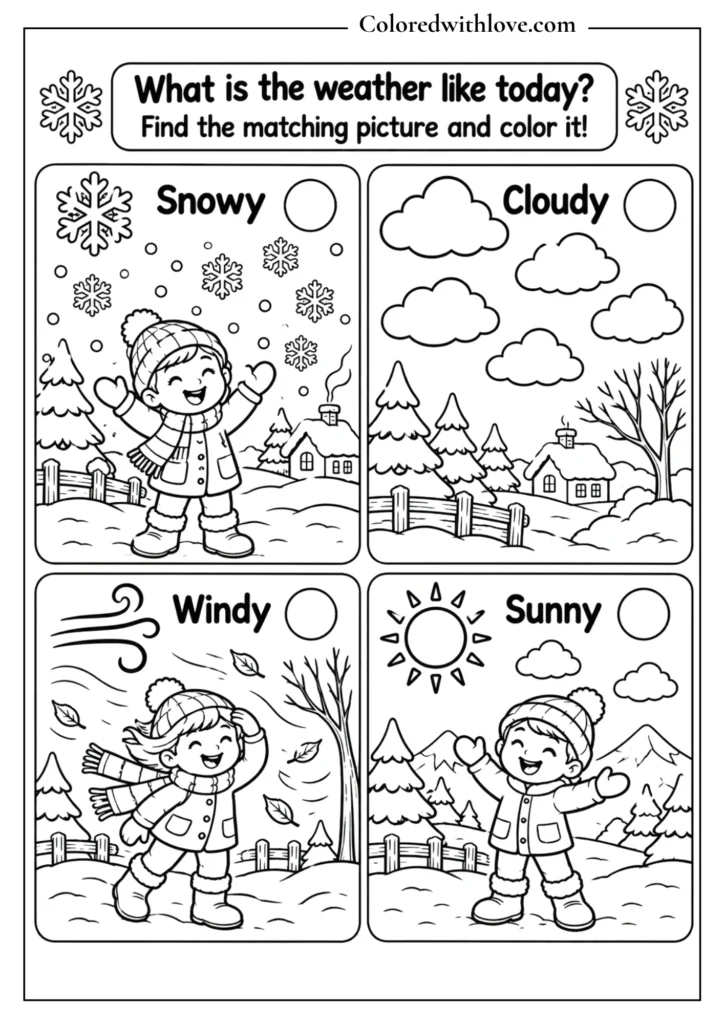
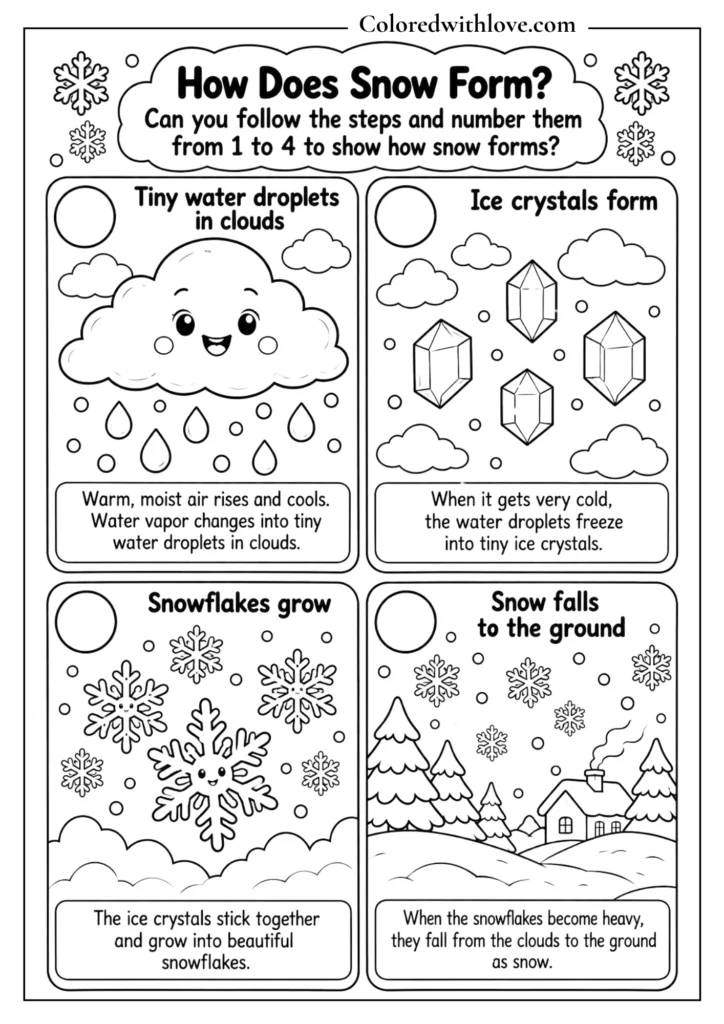
The collection includes activities about weather, snow formation, ice, and water. One page asks children to put the stages of snow formation in order, moving from tiny water droplets to ice crystals, growing snowflakes, and finally snow falling to the ground.
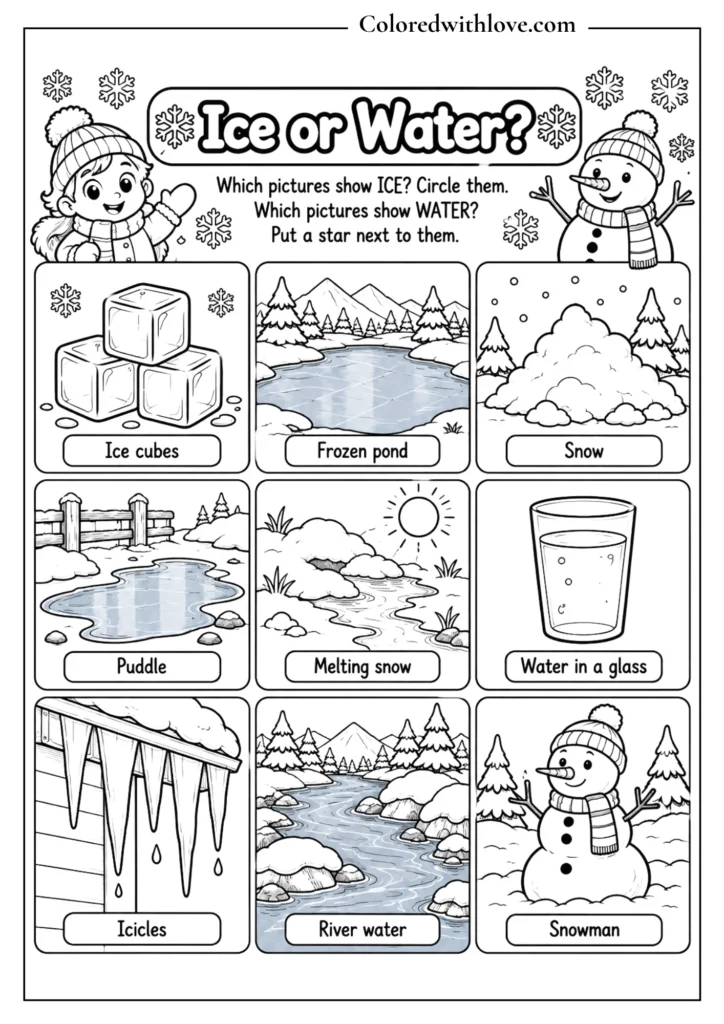
Another activity asks children to identify pictures showing ice versus water, including ice cubes, a frozen pond, melting snow, puddles, icicles, and river water.
This gives you an easy way to introduce words such as:
- Frozen
- Liquid
- Melting
- Ice
- Snow
- Puddle
- Water
4. Animals, Habitats, and Nature
Kids love animals, so why not use that curiosity as a learning tool?
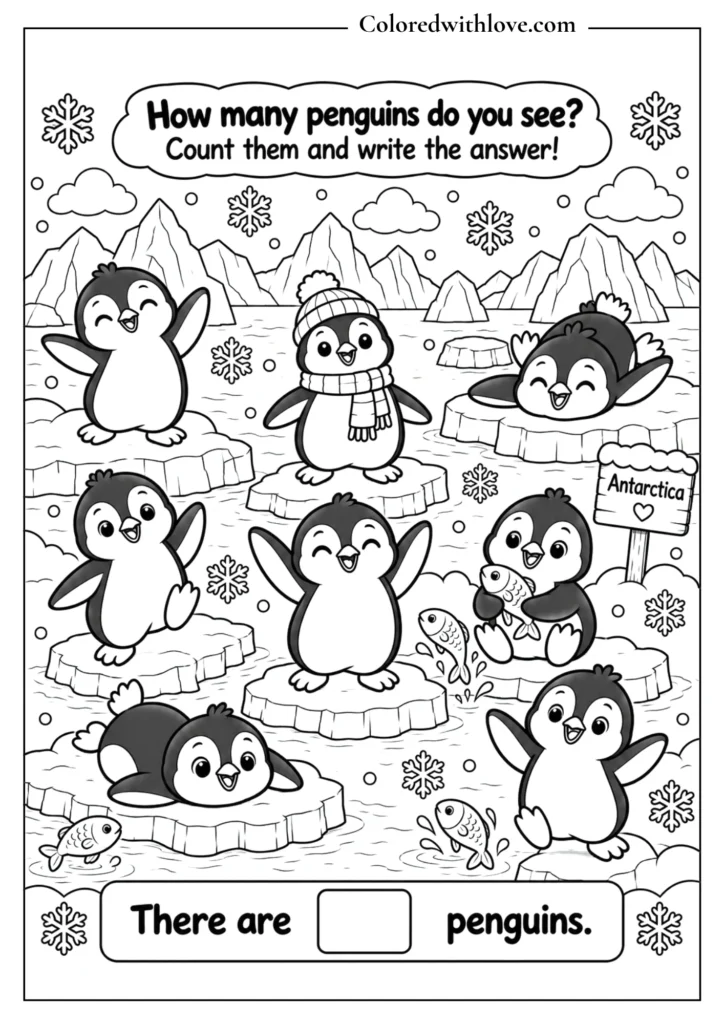
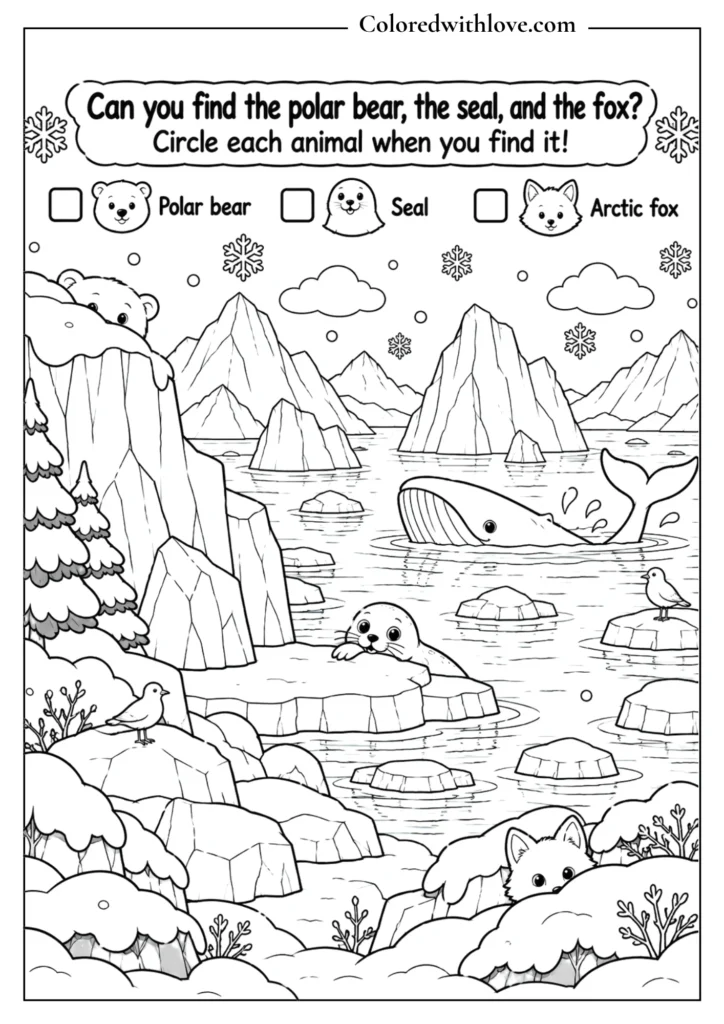
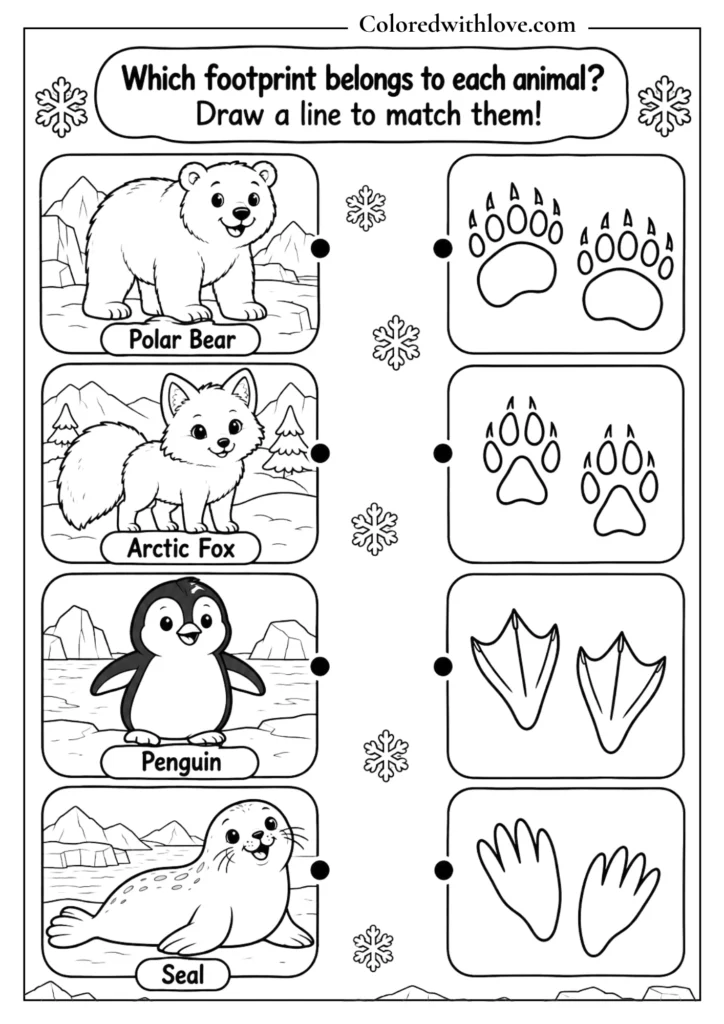
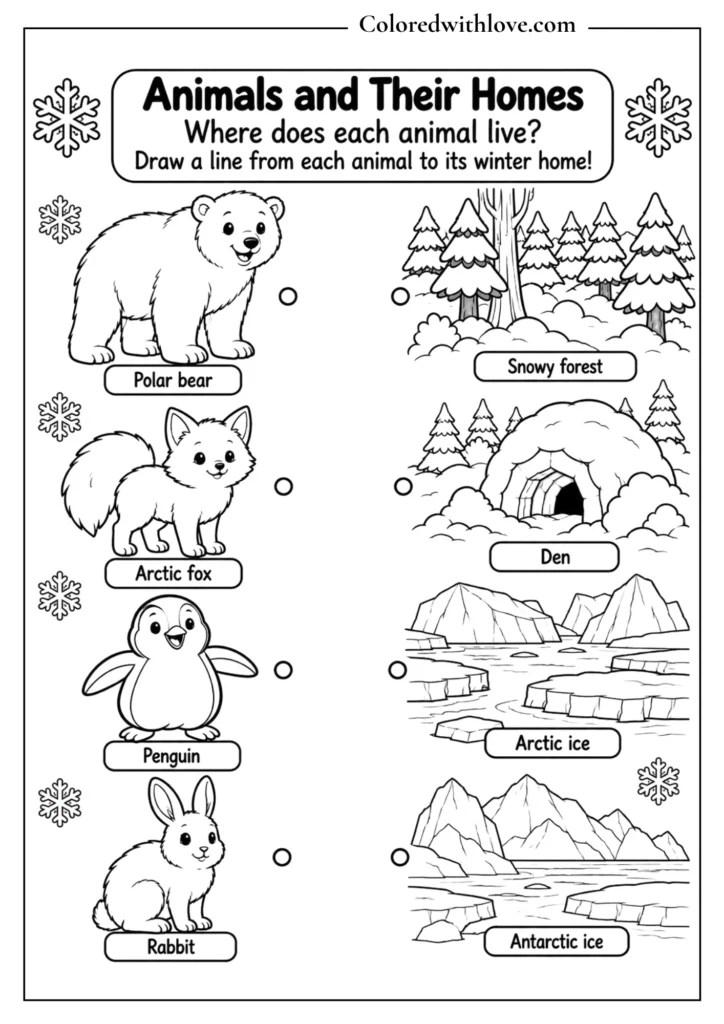
The collection includes polar bears, Arctic foxes, penguins, seals, rabbits, deer, foxes, birds, and other winter wildlife. Children can match animals to footprints, connect animals to their winter homes, count penguins, and search for animals in snowy landscapes.
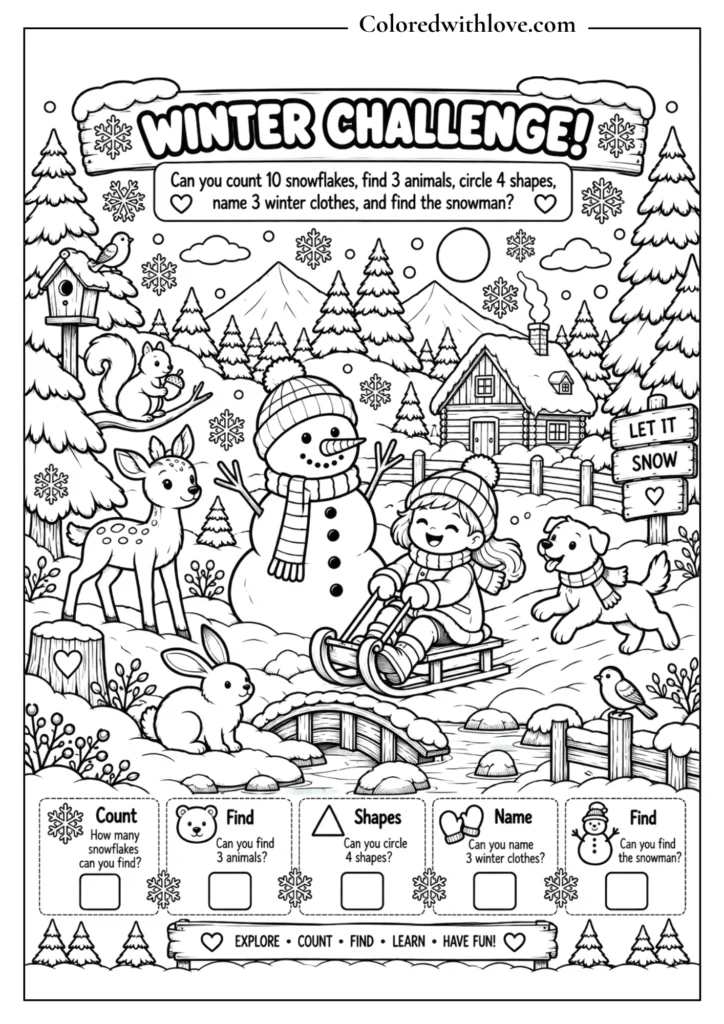
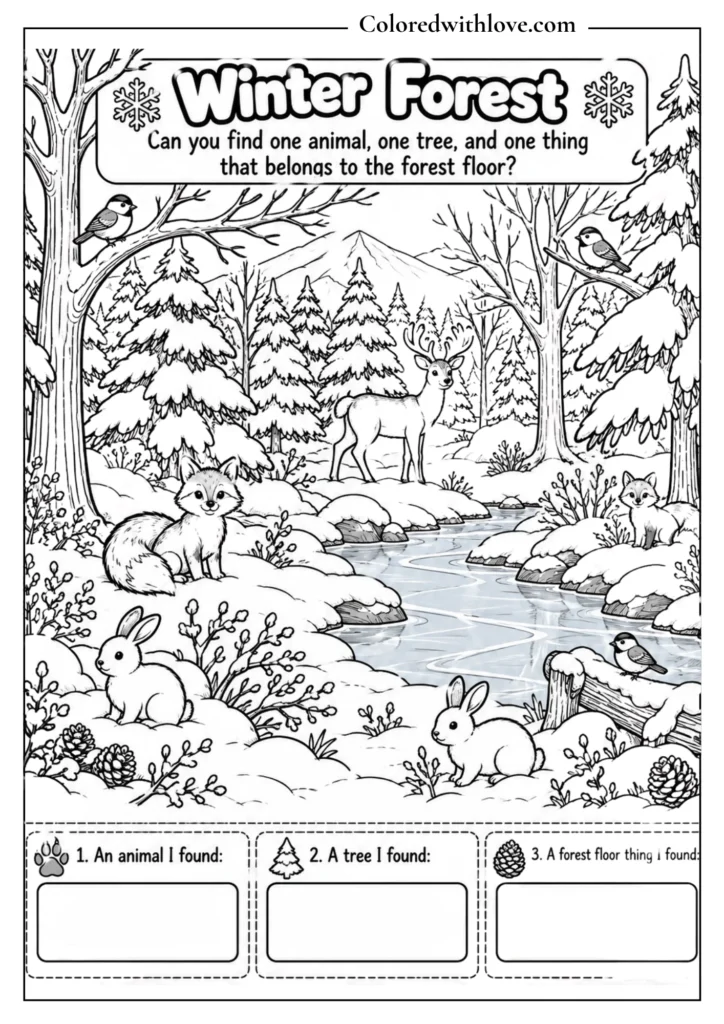
The Winter Forest activity is particularly useful for observation. Children must find one animal, one tree, and one object belonging to the forest floor, then draw or write their answers in the provided boxes.
It’s a small challenge, but it encourages careful observation, vocabulary development, and nature awareness.
Want to take the learning beyond the coloring page? Try observing the weather together. Children can record temperatures, look at clouds, talk about hot and cold, and make predictions about what the weather might be like tomorrow. These weather-learning activities from PBS KIDS offer simple ways to turn everyday weather observations into hands-on learning.
6. Sequencing, Routines, and Life Skills
Sequencing is an important early learning skill because it helps children understand order, routines, and cause and effect.
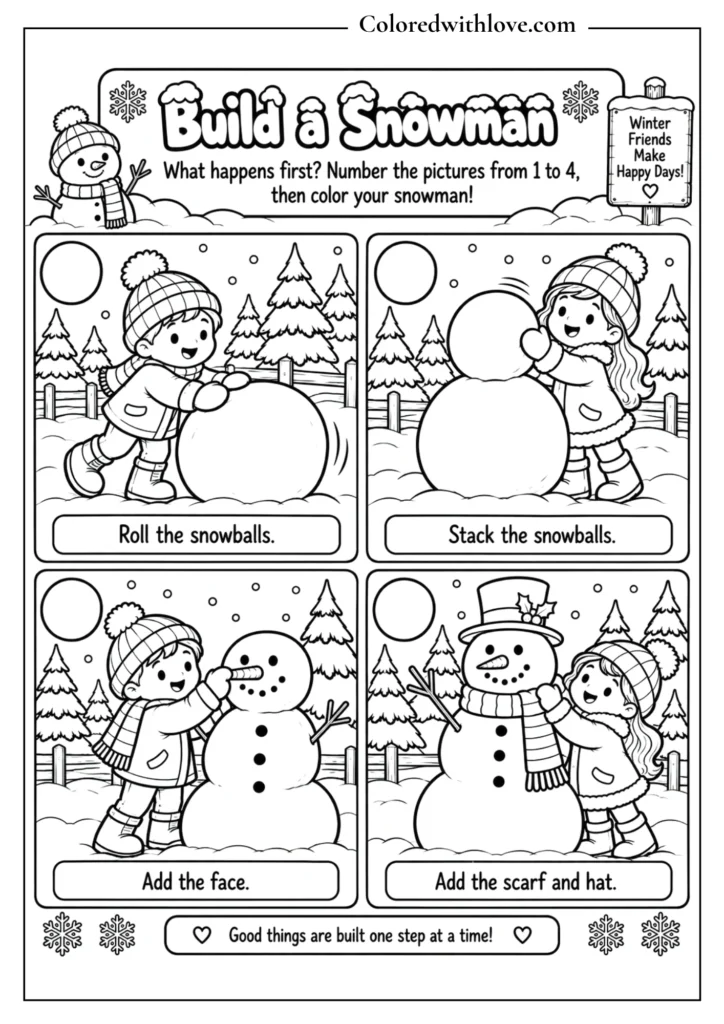
The Build a Snowman activity presents four distinct steps: rolling the snowballs, stacking them, adding the face, and adding the scarf and hat. Children number the pictures from 1 to 4 before coloring.
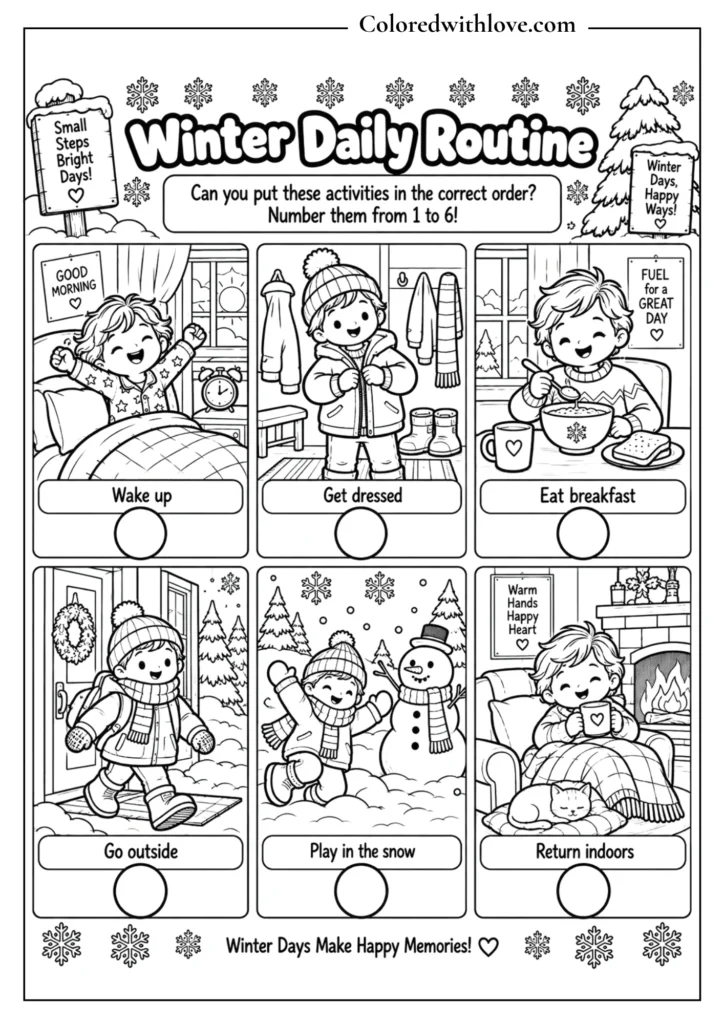
The Winter Daily Routine page follows six familiar activities: waking up, getting dressed, eating breakfast, going outside, playing in the snow, and returning indoors. Children number the scenes from 1 to 6.
These are simple exercises, but they help children practice chronological order and everyday vocabulary.
7. Winter Safety and Everyday Decisions
Winter also gives you a chance to talk about safe choices without making the lesson frightening.
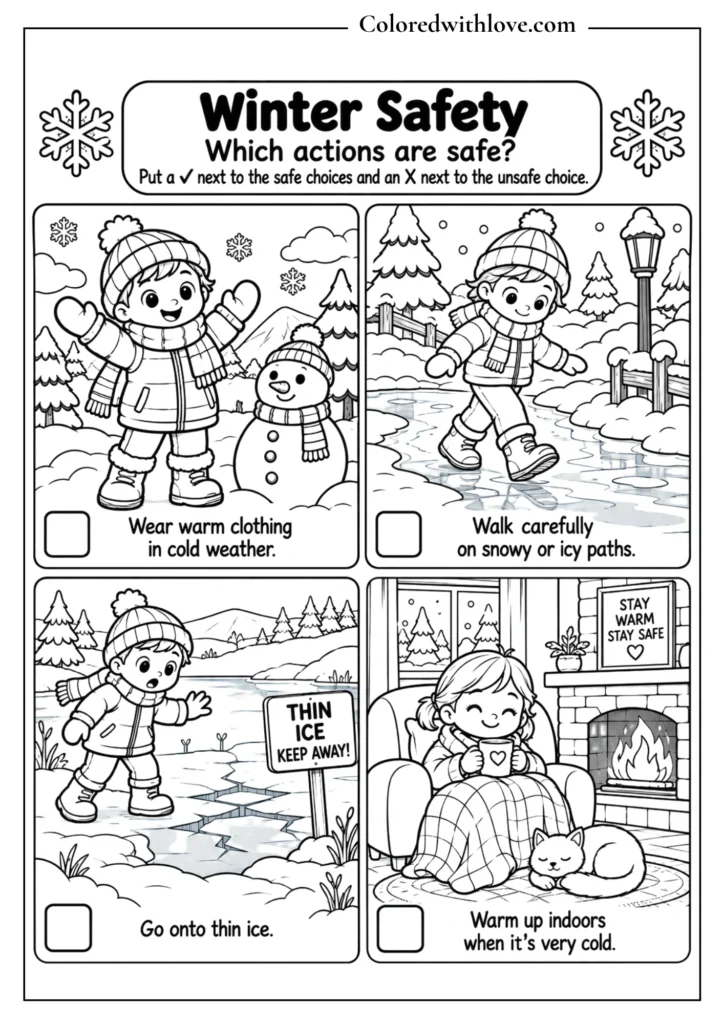
The Winter Safety page shows children wearing warm clothing, walking carefully on snowy or icy paths, staying away from thin ice, and warming up indoors. Children place a check beside safe choices and an X beside the unsafe action.
After coloring, ask:
“Why do you think this choice is safe?”
That short conversation can turn a five-minute worksheet into a useful real-life learning moment.
How to Make Educational Winter Coloring Activities Even More Effective
You don’t need a complicated lesson plan. Try these simple strategies:
1. Ask Before Explaining
Let your child look at the page first.
Ask, “What do you notice?” or “What do you think we need to find?”
2. Let Children Talk While They Color
Ask them to name objects, describe what they see, or explain their answers.
This adds language practice without making the activity feel like a test.
3. Start Easy and Increase the Challenge
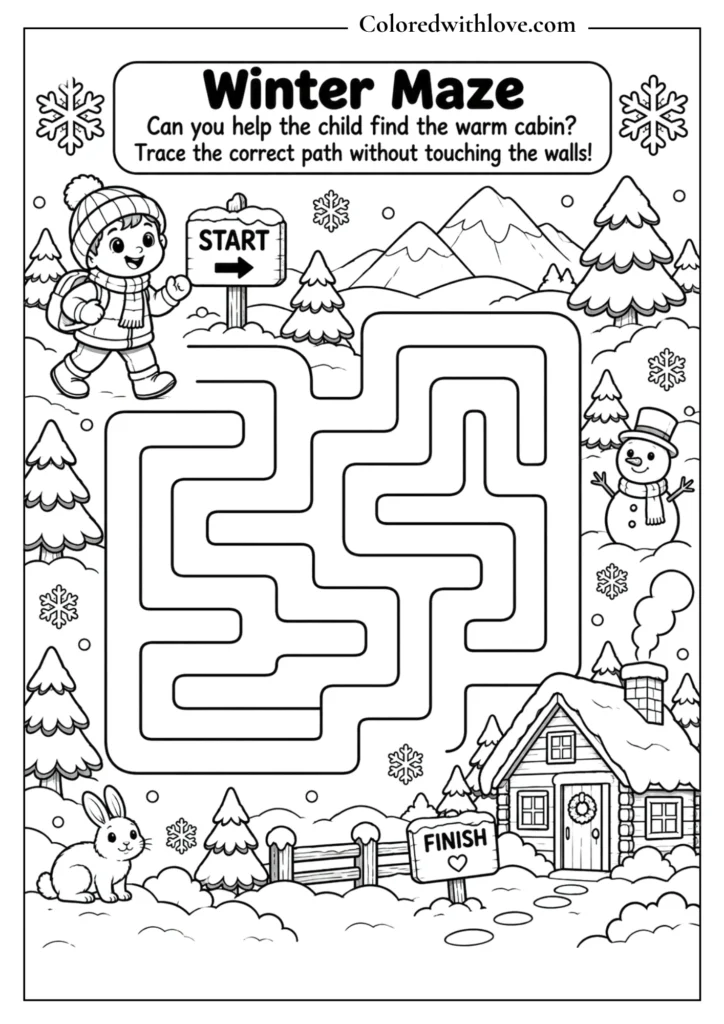
Begin with simple coloring, counting, and matching activities. Then move toward mazes, sequencing, word hunts, and math problems.
4. Use Real Objects
If you’re using the winter clothing activity, bring out a real hat, scarf, mitten, or boot.
Let children touch and name each item before coloring it.
5. Create a Winter Learning Folder
Keep completed pages in a folder. At the end of winter, children can look through their artwork and choose their favorite activity.
A Quick 15-Minute Winter Learning Routine
Short on time? Try this simple routine:
- 3 minutes: Look at the picture and discuss the topic.
- 5 minutes: Complete the interactive challenge.
- 5 minutes: Color the main scene.
- 2 minutes: Ask one follow-up question.
For example, after the Ice or Water activity, ask:
“What happens to snow when it gets warmer?”
After an animal activity, ask:
“Which winter animal would you most like to see, and why?”
This keeps the activity focused while giving children room to think, speak, and explore.
Why These Printables Are Perfect for Winter Break
Winter break can be a strange mix of excitement and “I’m bored!” ten minutes later.
A stack of Educational Winter Coloring Activities gives children something structured without making every moment feel like school.
The biggest advantage is flexibility. One page can be a quick five-minute activity, while several pages can become a complete afternoon learning session.
You can also use selected pages for:
- Classroom learning stations
- Homeschool lessons
- Winter break activities
- Quiet-time baskets
- Travel activities
- Early-finisher work
- Parent-child learning
- Screen-free afternoons
For more printable inspiration, you can also explore Coloring Pages for Kids with Examples and Cozy Cottage Coloring Pages.
Ready to Turn Coloring Time Into Learning Time?
These Educational Winter Coloring Activities are designed to make winter learning playful, visual, and hands-on.
Across the 30 pages, children can practice counting, early addition, vocabulary, letter recognition, matching, sequencing, observation, science concepts, animal recognition, safety awareness, and problem-solving while enjoying snowy scenes and friendly winter characters.
Instead of asking children to choose between learning and having fun, give them an activity that does both.
Print a few pages, grab the crayons, and ask one simple question:
“What can you discover today?”
If your child enjoys learning through coloring, you can keep the fun going with more simple and engaging activities. Explore our collection of coloring pages for kids for additional printable designs that are perfect for quiet time, classroom activities, or creative play.